
Emancipation Celebration Monument
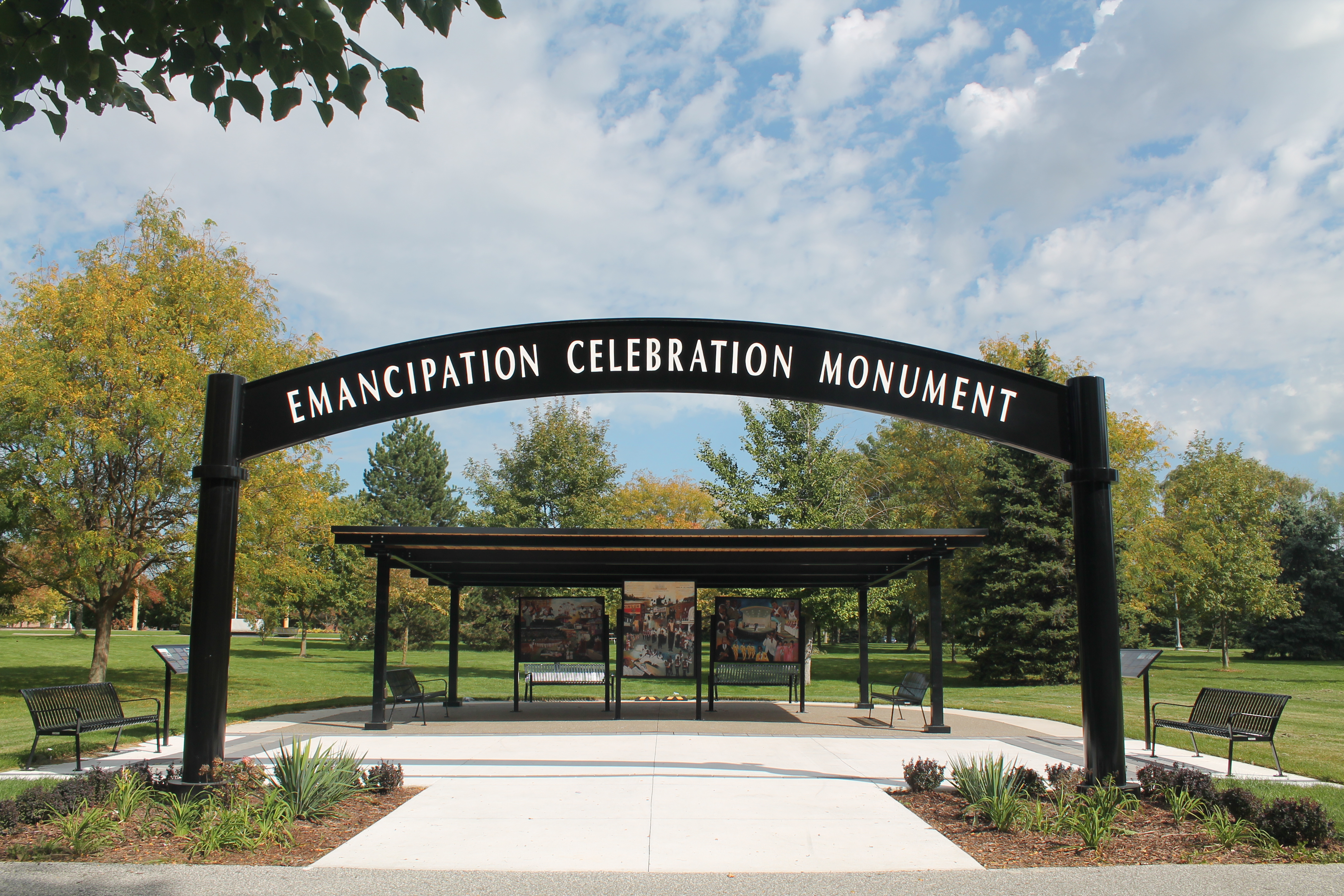
The City of Windsor is moving forward with the much-anticipated Emancipation Celebration Monument at Jackson Park.
The monument and gathering space will be constructed at Jackson Park (125 Tecumseh Road East) between May and July of 2026. The finished monument will include a large decorative archway that will be 28 feet across and nearly 15 feet high, built to reflect the shape and style of the proscenium of the original Jackson Park bandstand, which burned down in 1957. Other elements of the Monument include:
- Three murals created by local artist Dennis K. Smith, cofounder and president of The Artists of Colour, depicting the history of Emancipation Day celebrations in Windsor through large-scale outdoor framed paintings;
- Interpretive panels sharing historical information and images connected to the local history of Emancipation Day and Windsor-Essex local Black history, with QR code technology linking to a commemorative website;
- Decorative benches, landscaping, lighting, and shade structures to enhance the overall user experience of the site;
- Space for future installation of a life-size bronze sculpture of Walter Perry;
- Pathways with opportunities for donor names on bricks around the site; and
- An overall footprint that also reflects the shape of the original bandstand.
The Emancipation Celebration Monument and gathering space at Jackson Park is supported by an investment of over $400,000 from City Council through the City of Windsor’s 2026 budget. The monument was completed in late July 2026. The volunteer Emancipation Celebration Monument Committee hosted a grand opening and ribbon-cutting ceremony on Saturday, August 1, 2026 - in honour of Emancipation Day.
Emancipation Celebration Monument Committee:
Mayor Drew Dilkens, Councillor Renaldo Agostino, Joi Elaine Hurst (Co-Chair), Gale Carter (Co-Chair), Laura Williams, Dennis K. Smith, Mark Williams, Ryan Falloon, James Chacko, Christopher Menard, Wadah Al-Yassiri, Laura Ash, Darron Ahlstedt, Hoda Kameli, Pam Mady, Michael Okanlawon. With support from Donna Jean Mayne and Fina Pirrone.
The History of Emancipation Day Celebrations in Windsor
Researched and written by Irene Moore Davis, Historian, Assistant Curator, Amherstburg Freedom Museum
This text appears on two interpretive panels located on site at the Emancipation Celebration Monument in Jackson Park.
Emancipation Day in Canada
Communities of African descent across Canada have been celebrating Emancipation Day since the 1830s. In the Canadian context, Emancipation Day commemorates August 1, 1834, when the Slavery Abolition Act of 1833 prohibited slavery across most of the British colonies including British North America (Canada.) The Slavery Abolition Act, which received Royal Assent on August 28, 1833 and took effect August 1, 1834, provided a pathway to freedom for over 800,000 enslaved people across the British Empire.
The Slavery Abolition Act made slavery illegal across British colonies in the Caribbean, Latin America, and Canada, where thousands of people of African and Indigenous heritage had been enslaved during both the French and British colonial regimes. Widespread slavery had been practiced in Nova Scotia, New Brunswick, Prince Edward Island, and the provinces now known as Quebec and Ontario, including Windsor and other communities in the Detroit River Region.
The end of slavery in the British Empire can be attributed as much to revolts and resistance by enslaved Africans across the colonies as to the efforts of sympathetic white abolitionists. By the early nineteenth century, after more than two hundred years of rebellions by enslaved people throughout British colonies and particularly after the Haitian Revolution through which enslaved Africans won a thirteen-year war with France and established the first Black-led, independent republic in the Americas, many in Great Britain came to understand that slavery must end gradually via peaceful means.
In some colonies, the Slavery Abolition Act immediately offered complete emancipation; in others, the Act freed children under the age of six but required the remaining enslaved people to labour as apprentices until 1837 or 1838. In Canada, where slavery had existed since the seventeenth century but where relatively few people were still living in bondage by the 1830s, the Slavery Abolition Act freed enslaved people as well.
The local impact of the Slavery Abolition Act of 1833 was not merely relevant to those people who had experienced slavery here in British North America; to a far greater extent, it was the catalyst for innumerable Underground Railroad journeys north to freedom in Canada. The Slavery Abolition Act made Canada a desirable destination for thousands seeking liberation from chattel slavery in the United States. Historians estimate that between 30,000 and 40,000 enslaved African Americans escaped to Canada at the peak of the Underground Railroad, drawn by the promise of freedom despite dangerous and difficult conditions along the way.
From Owen Sound where annual celebrations have occurred continuously since 1862, to the world-famous Toronto Caribbean Carnival (formerly Caribana) founded in 1967, Emancipation remains an important observance for Black Canadians and allies. In Windsor, Ontario (including Sandwich, formerly a separate town before amalgamation) where many Underground Railroad ancestors seeking freedom from chattel slavery in the United States found refuge, Emancipation has particularly special meaning.
Early Emancipation Day Celebrations in Windsor and Sandwich
Locally, from the 1830s on, annual Emancipation festivities took place in a variety of locations across Windsor and Sandwich: private properties, public spaces such as parks, groves, or mineral springs, barracks, churches, and the banks of the Detroit River itself. Each year, these events were a vibrant example of transnationalism, drawing visitors from Canada and the United States alike. For example, the legendary boxer Jack Johnson appeared at the 1909 Emancipation celebration in Lagoon Park (Sandwich) before an estimated crowd of 10,000.
From the beginning, Emancipation celebrations in Windsor and Sandwich included speeches, sermons, concerts, parades, boat rides, dinners, toasts, sporting events, and balls. By the early twentieth century, midway rides and sideshows had become popular additions.
For decades, from the 1930s until the 1960s, Jackson Park was at the heart of Windsor, Ontario’s annual Emancipation festivities, organized by Walter Perry and the British American Association of Colored Brothers. This spectacular iteration of the annual celebration became known as “The Greatest Freedom Show on Earth.”
Commemorating Emancipation Today
Today, the celebration of Emancipation continues in Underground Railroad descendant communities across Ontario, including but not limited to festivities in Chatham-Kent, London, Halton, Kitchener-Waterloo, and Owen Sound where the annual celebration has been held continuously since 1862. In Toronto, annual Emancipation celebrations have evolved into the world-famous Toronto Caribbean Festival, formerly known as Caribana — an event rooted in the liberation of people enslaved in British colonies throughout and adjacent to the Caribbean. Locally today, Emancipation events are hosted annually by organizations such the Amherstburg Freedom Museum and the Black Council of Windsor-Essex with many individuals and groups collaborating.
On March 24, 2021, after years of advocacy by Black Canadians such as longtime Ontario Black History Society President Rosemary Sadlier and Senator Wanda Thomas Bernard, Canada’s House of Commons voted unanimously to officially designate August 1 Emancipation Day. Annually, Canadians are encouraged to reflect on the meaning of freedom, our nation’s complicated history of slavery and resistance, and the strength and determination of generations of Black Canadians. Like the Tower of Freedom in Windsor’s Civic Green, may this space encourage you to reflect on our individual and collective responsibility towards keeping the flame of freedom alive.
All Roads Led to Jackson Park
Annually, Windsor’s Emancipation parade featured marching bands, beauty queens, drill teams, fraternal organizations, and dignitaries. The route stretched down Ouellette Avenue from Riverside Drive to Jackson Park along Tecumseh Road, where revellers would delight in a midway, talent shows, music and entertainment, sporting events, speeches, inspiring worship services, and tantalizing food including the famous barbeque pits from which the scent of chicken and ribs emanated to the limits of the park. Black vendors lined the space, offering delectable foods. Local Black churches and organizations sold desserts that delighted the crowd and supported important community initiatives. For many of Windsor’s Black youth, the annual Emancipation celebrations provided their first paid employment opportunities at a time when hospitality and service industries were rife with racial discrimination.
Entertainers such as the Supremes, Stevie Wonder, the Temptations, Dorothy Dandridge, and W.C. Handy, as well as famous athletes such as Joe Louis and Jesse Owens appeared at Windsor’s Emancipation. People of all ethnicities participated in the festivities, precisely as Walter Perry and the BAACB had planned.
In an era when Black women were subject to harsh stereotypes regarding their appearance and attributes, and when few had access to pageants or modelling opportunities, the annual Miss Sepia contest celebrated their beauty and accomplishments. Young women from across the Great Lakes Region and beyond took great pride in competing for the coveted Miss Sepia crown.
A Celebration Rooted in Activism
From the very beginning, local Emancipation celebrations highlighted social justice themes. From the 1930s onward, Windsor’s Emancipation focused on advancing rights, opportunities, and equality for people of African descent locally, nationally, and internationally. The organizers encouraged discussion about the barriers preventing the advancement of Black people while also shining a light on examples of Black excellence and achievement. Awards were presented to Black leaders and allies, showcasing all that was achievable despite the multiple barriers presented by the broader society.
Guest speakers included U.S. Congressman Adam Clayton Powell, pioneering educator Mary McLeod Bethune, and former First Lady Eleanor Roosevelt. In the peak Civil Rights era, Windsor’s Emancipation drew leaders such as Martin Luther King, Jr., who came in the midst of the Montgomery Bus Boycott, William Holmes Borders, Fred Shuttlesworth, Wyatt Tee Walker, Daisy Bates, and Myrlie Evers who addressed the spellbound crowd just six weeks after her husband’s assassination.
Progress: Chronicling the Black Experience
In 1948, the BAACB launched "Progress: An Official Record of the Achievements of the Coloured Race" as the annual publication which would accompany the Emancipation festivities. Much more than a program or a schedule of events, "Progress" included information about the guest speakers and performers who would be featured at that year’s festival, biographical sketches about successful people of African descent, and commentaries on contemporary Black life. Often it included an editorial piece by Walter Perry himself. In the inaugural issue, Perry wrote, “All of us look to a bright future… an era which finds us accepted for our qualities as citizens… as men and women with a contribution to make to our country.”
"Progress" celebrated the success of many Black Canadians and African Americans who were excelling in their fields, examined the discrimination and segregation experienced by Blacks locally and internationally, encouraged support of local Black businesses, and described in detail the Civil Rights and Black liberation movements happening in Canada, the U.S., and around the world.
The Decline of the Greatest Freedom Show on Earth
Years of financial woes threatened the future of Windsor’s Emancipation celebrations despite the event’s immense economic benefit to the city and region. Then a disastrous fire in 1957 destroyed the Jackson Park grandstand and bandshell. In 1959, a new bandshell was approved and built, but the park was split to accommodate a new overpass. The Detroit Uprising of 1967 led the City of Windsor to force the cancellation of Emancipation due to security concerns. When celebrations were once again allowed, with Emancipation relocated to Mic Mac Park on the west side of Windsor, attendance never returned to its pre-1967 levels. After Perry’s death in 1967, the festival was chaired by Edmund (Ted) Powell from 1968 until 1984, then by several successive host organizations. Smaller-scale Emancipation celebrations in Windsor continue to this day.
Emancipation Celebration Monument Murals
Three murals conceived of and painted by local artist and President and Co-Founder of the Artists of Colour Dennis K. Smith
These three murals are installed on site at the Emancipation Celebration Monument at Jackson Park.
Content written by Dennis K. Smith.
Artist Statement on the Murals:
“Emancipation was eating ribs with sticky fingers, while dressed in our Sunday best. It was more than a parade; it was a pageantry of progress. I’m honoured to be a part of this project and to have the opportunity to help tell these stories through my art."
Mural One - Here Comes the Bands
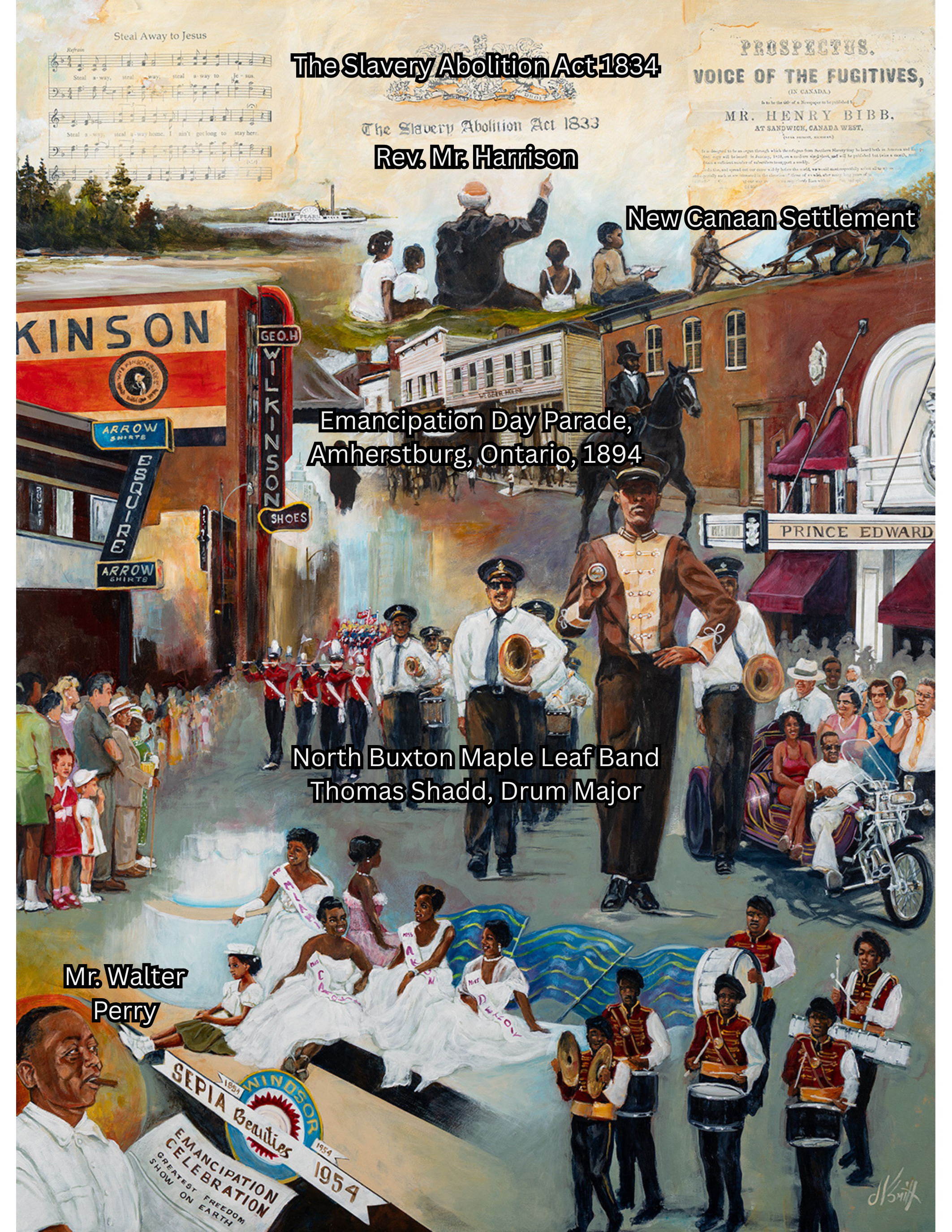
The top left corner of panel one, you will see the song “Steal Away." It is believed that songs like "Steal Away" and "Wade in the Water" had double meanings for the slaves who sang them. Not only did the words reflect their faith and that they would one day “steal away to Jesus,” but also acted as code to their fellow workers that they were going to seek to escape their slave-owners, that they would “steal away” via the secret network called the Underground Railroad that would help them reach the northern United States or Canada where they would reclaim their freedom. Beneath the song lyrics is a depiction of the Steamship Pearl. The Pearl regularly travelled the waters between Detroit, Amherstburg, and other Lake Erie ports during the 1850s and 1860s. On this passenger and trade the Pearl routinely carried self-emancipated individuals and newly arrived Black families seeking sanctuary and employment in Essex County.
The top centre figure is Windsor resident, the Reverend William Harrison, whose parents escaped from the yoke of slavery. He is seen here seated on the banks of the Detroit River. Four children sit beside him listening intently as he gives them a history lesson.
The top far right is the image of The Voice of the Fugitive. This was Canada's first Black newspaper. It was founded by abolitionists Henry Bibb and his wife Mary, who was a co-editor. The Sandwich Town newspaper served as a key communication tool for the Underground Railroad. It promoted Canada as a safe haven for freedom seekers and connected abolitionist networks across the United States and Canada. Below this image is an early New Canaan settler, clearing his land.
Directly below, seated on his horse, is Grand Marshal Moses Brantford Jr. leading the 1894 Emancipation Day parade on Dalhousie Street in Amherstburg, Ontario. In 1935, the region's main Emancipation celebrations moved to Windsor.
Front and centre leading the parade is the North Buxton Maple Leaf Band with Drum Major Thomas Shadd proudly leading the band in his ceremonial uniform and holding a mace.
The parades are my most memorable part of the Emancipation Celebrations because of my personal participation in it. I was a band member of the Harrow IGA Marching Band, and this parade was the biggest and seemed at the time to be the longest. My brothers and I still boast that the Harrow IGA Band was Walts’ favourite Band. Our most repeated song throughout the parade route was “Happy Days Are Here Again,” and we played it with great enthusiasm and marched with pride in our stride. The marching bands played a very significant role in the parade not just because of the music but because of the different ethnicities that participated in the parade.
Mural Two - Fun, Food and Folk
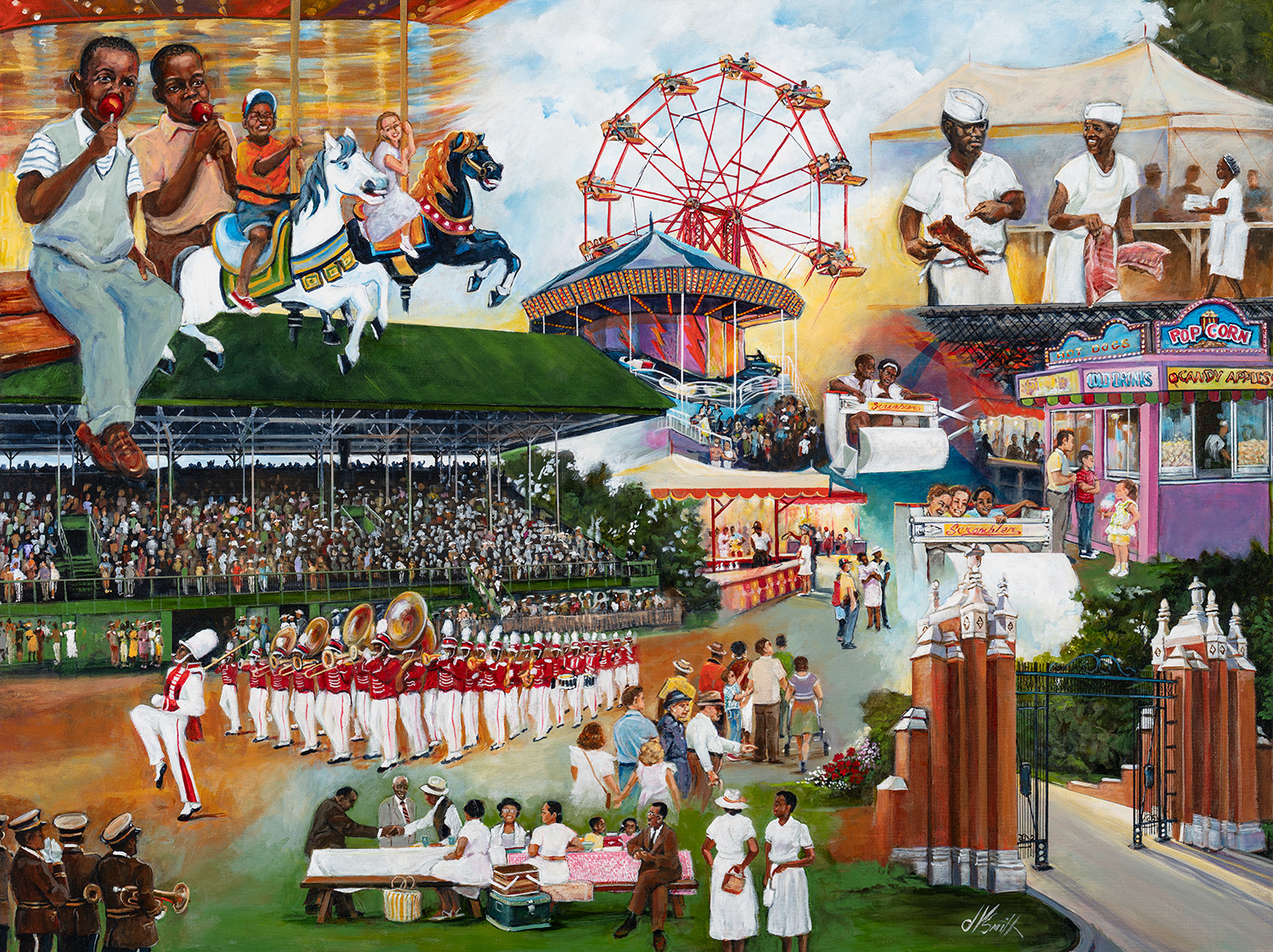
The Parade would conclude as the bands and dignitaries passed in front of the packed Jackson Park Bandstand. In the 1950s, the procession would have paraded past the Old Grandstand as well. The Jackson Park Grandstand was a famous 5,000-seat wooden landmark that was destroyed by a massive fire on July 13, 1957. Thousands packed that Grandstand in 1946 to watch the Miss Sepia beauty contest held on the stage in front of the Grandstand as part of the Emancipation Day Celebrations.
The Main Gates of Jackson Park seen at the bottom right of the panel welcome the viewers of this painting into the park. I chose not to add the gates to this image to create a more welcoming invitation to follow the pathway into the painting. The entrance gates, constructed in 1931, were designed by Pennington and Boyde Architects.
The Ferris Wheel at the top and the Carousel below were the busiest rides. The Carousel with its brilliantly painted wooden animals, mirrored panels and twinkling ceiling lights was too boring of a ride to me, but I found it amazing to look at. Then there was the Waltzer and Scrambler which were my favourite rides. The Midway was packed with people whose exuberant shrieks were heard above the loud calliope tunes created by mechanical organs and brass bands. These energetic and repetitive rhythms would lure us in like a magnet, to experience the adventure of the different rides. The sound of buzzing neon signs and the smell of caramel corn and sweet funnel cakes and candy apples would heighten the overall experience in the evenings. Then there were the ribs — smoky and tender, smothered with Walt’s secret BBQ sauce... now this was serious eating. But for me, hot dogs were all that my budget would cover. For many, their food came in picnic baskets and paper bags. That’s where kin, friends and church folk would grab a table and claim it for the afternoon. After all, that’s what the celebration was about: unity. And for many, sharing your food and stories. For the majority, we call it “Breaking bread together.”
Mural Three - Celebrate Black Accomplishments
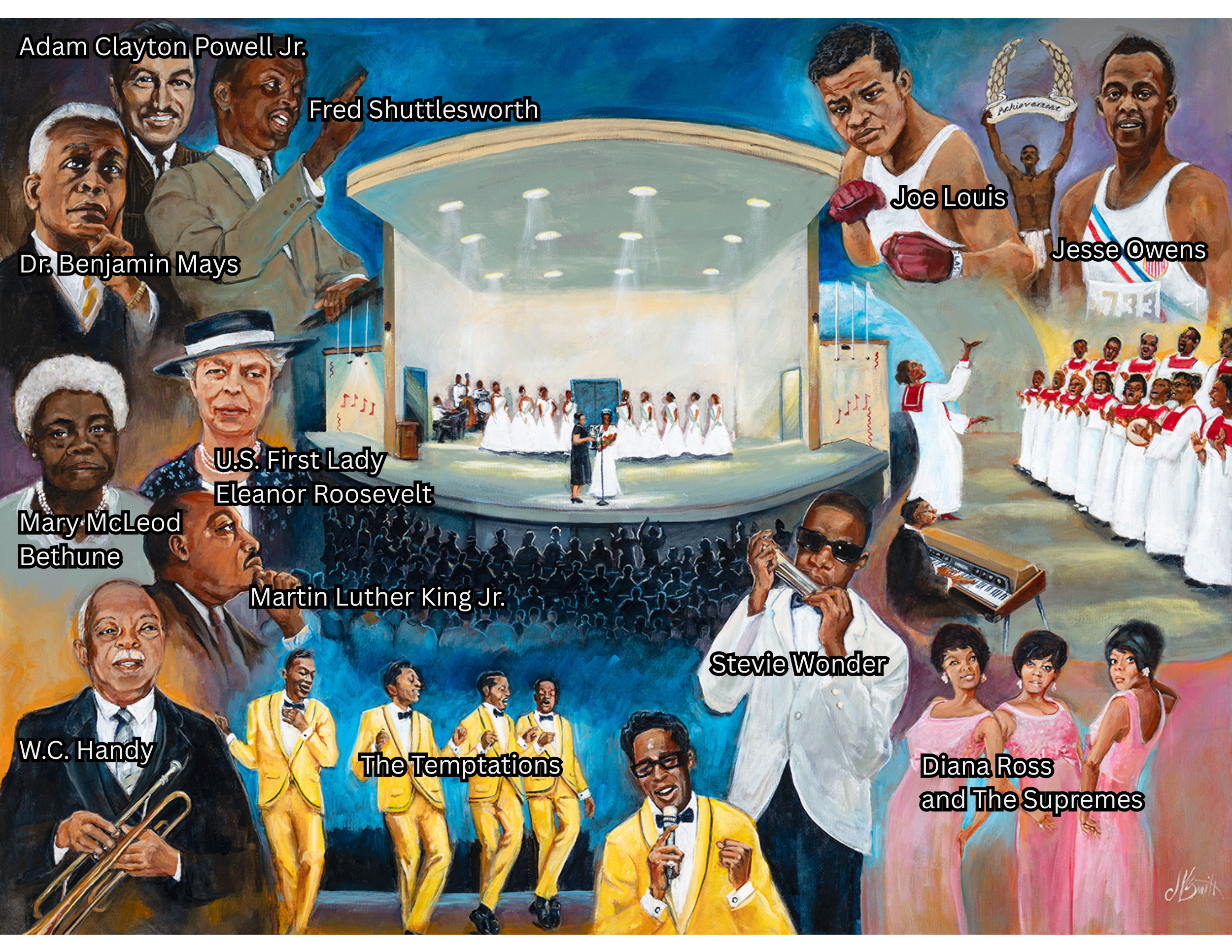 The present-day Bandshell takes centre stage in this painting; many meaningful memories happened upon this stage. The original Bandstand was built in 1950, but was destroyed by fire in 1957. In 1959, Windsor City Council approved the construction of the second replacement Bandshell. Upon this stage, world-class musicians and notable dignitaries delivered arousing speeches and great performances. Some of the most prominent keynote speakers and special guests who took the stage at either the original Bandstand or the replacement Bandshell, are, from top left:
- Adam Clayton Powell Jr. Member of the U.S. House of Representatives from New York. Powell became chairman of the Education and Labor Committee.
- Fred Shuttlesworth, civil rights activist.
- Dr. Benjamin Mays, a prominent civil rights leader and mentor to Martin Luther King Jr. who attended the Emancipation Celebrations in 1956.
- Eleanor Roosevelt, U.S. First Lady, diplomat, and activist instrumental in shaping and passing the Universal Declaration of Human Rights.
- Mary McLeod Bethune, renowned educator and civil rights leader who founded the National Council of Negro Women.
- Martin Luther King, Jr., America's preeminent advocate of nonviolence and one of the greatest nonviolent leaders in world history.
- W.C. Handy -celebrated composer, given the designation "Father of the Blues."
In addition to these monumental civil rights leaders and guest speakers, the event featured musical performances by Motown legends like The Temptations, Stevie Wonder, Diana Ross and The Supremes, and more. There were also special guest appearances by people like Gold Medallist Jesse Owens and World Heavyweight Champion boxer, Joe Louis. The image of Detroit heavyweight boxer Alfred Hunter is placed between Joe Louis and Carl Owens. Hunter was the model for the cover of the 1948 "Progress" Magazine. The "Progress" Magazine highlighted the accomplishments of Black Canadians during an era of heavy segregation. The booklets featured event schedules, messages of racial harmony, and local business ads.
The Emancipation Day celebrations also included a Sunday service and Gospel concerts, talent shows and sporting events. But the largest draw came Monday nights, when the Miss Sepia Beauty Pageant took hold on centre stage.
Reflections on Freedom
These quotes are included on the back side of the Emancipation Celebration Monument Murals at Jackson Park.
They were curated by Irene Moore Davis.
“I’ll use my freedom well.” – Josiah Henson
“The Freedom Gates are half-ajar. We must pry them fully open.” – Mary McLeod Bethune
“For to be free is not merely to cast off one’s chains, but to live in a way that respects and enhances the freedom of others.” – Nelson Mandela
“God’s time is always near. He set the North Star in the heavens; He gave me the strength in my limbs; He meant I should be free.” – Harriet Tubman
“I prayed for freedom for twenty years, but received no answer until I prayed with my legs.” – Frederick Douglass
“Life is a hard battle anyway. If we laugh and sing a little as we fight the good fight of freedom, it makes it all go easier.” – Sojourner Truth
“Freedom is never voluntarily given by the oppressor; it must be demanded by the oppressed.” – Martin Luther King, Jr.
“Find your voice. Raise your voice. Let yours be a voice for freedom.” – Ellen Johnson Sirleaf
“Freedom is not something that one people can bestow on another as a gift. They claim it as their own and none can keep it from them.” – Kwame Nkrumah
“We have to talk about liberating minds as well as liberating society.” – Angela Davis
“We are going to emancipate ourselves from mental slavery, for though others may free the body, none but ourselves can free the mind.” – Marcus Garvey
“You can’t separate peace from freedom because no one can be at peace unless he has his freedom.” – Malcolm X
“I would like to be known as a person who is concerned about freedom and equality and justice and prosperity for all people.” – Rosa Parks
“Consistent action is the key to emancipation.” – Henry Bibb
“There is in this world no such force as the force of a person determined to rise. The human soul cannot be permanently chained.” – W.E.B. Du Bois
“Never be limited by other people’s limited imaginations.” – Mae Jemison
“Exclusion is never the way forward on our shared paths to freedom and justice.” – Desmond Tutu
“Bringing the gifts that my ancestors gave, I am the dream and the hope of the slave.” – Maya Angelou
Fundraising Campaign Launched for Life-Size Bronze Sculpture of
"Mr. Emancipation" Walter Perry
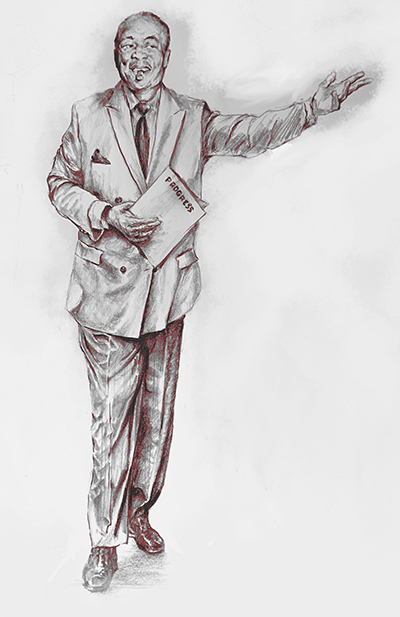 As part of the Emancipation Celebration Monument's future evolution, sculptor Mark Williams, who created the Hiram Walker Commemorative Sculpture and the Tecumseh and Brock Monument, among many other regional sculptures in Windsor-Essex, will create a life-size bronze sculpture of Walter Perry. Affectionately known as "Mr. Emancipation," Walter Perry was the man who organized Windsor’s historic Emancipation Day celebrations, designing the progressive festival that flourished during one of the most significant times and places in North American history. For thirty years, Perry helped transform his hometown into the place it is now. His story, and the history of the festival he created, is the subject of the 2020 Canadian documentary "Mr. Emancipation: The Walter Perry Story."
The sculpture is intended for creation and installation in 2027 or sooner, subject to meeting a community fundraising goal. The City and the Emancipation Celebration Monument Committee have partnered with the WindsorEssex Community Foundation (WECF), who will serve as stewards of the Emancipation Celebration Fund. WECF is a perpetual community trust for philanthropic purposes. It exists to manage donors’ legacy funds and make grants to support local community programs.
Donation link: To donate online, and for details on donating by cheque or by phone, please visit the Emancipation Celebration Fund project donation page.
Emancipation Celebration Monument Commemorative Brick Program
Additionally, the City has launched a special Emancipation Celebration Monument Commemorative Brick Program, offering an opportunity for those interested in the project to make their mark on helping bring it to life with a commemorative brick installed around the site. Donations of $100.00 will allow for:
- One grey 6-inch by 12-inch brick with a name or message inscribed
- Three rows for the inscription
- 16 characters per row, including spaces/punctuation
Funding raised through this commemorative brick program will be directed towards creation and installation of the bronze sculpture of Walter Perry and will help the fundraising committee reach its community fundraising goals. Donors are responsible for the regular maintenance of the brick. Replacement of any brick due to normal wear and tear shall be at the expense of the purchaser. Donors will receive a certificate for their brick, along with an income tax receipt from the City of Windsor.
To Donate:
- To donate and receive an Emancipation Celebration Monument Commemorative Brick, please complete the Jackson Park Commemorative Brick Program Brochure/Order Form.
For assistance, contact Parks, Recreation & Facilities at 519-253-2300 ext. 2711 by phone, or parkrec@citywindsor.ca by email.
"The Emancipation Celebration Monument at Jackson Park will be something truly special to behold. From the large archway that mirrors the shape and design of the original bandstand… to the original murals being created by artist Dennis K. Smith… to the interactive elements, benches, lighting, shade structure, and other planned features of the overall space… to the life-sized bronze sculpture of Walter Perry to be installed in the near future — we are honouring our commitment to make 'Mr. Emancipation' proud as we honour 'The Greatest Freedom Show on Earth,' and create a fitting and inspiring tribute to a shared history that shaped our city, province, and country. We are investing responsibly in public art, parks, culture, and heritage through this project. As the fundraising stage officially kicks off for the bronze sculpture component, I thank Council for approving the over $400,000 investment to make this happen, Joi Hurst, Gale Carter, all members of the Committee, along with the designers, artists, and community members working in lockstep with the City to bring this beautiful vision to life in Jackson Park. Windsor is one of Canada’s most inclusive communities, and we are certainly honouring that through this monument and the other funding announcements supporting multiculturalism, diversity, and the stories that have helped to shape the community that is home to us all."
- Windsor Mayor Drew Dilkens
"Windsor has long been a place of refuge for freedom seekers and those who fight for independence, safety, and stability. Emancipation Day celebrations helped to shape our community, and it’s amazing to see the stunning design of the monument and sculpture that are being created to honour that history today. It has been an honour to partner with Mayor Dilkens, the committee members and artists, to get the project to this exciting milestone. Of course, I’m thrilled to see this come to life in Ward 3, where a continued commitment to public art helps Strengthen the Core and attract new investments, businesses, residents, and visitors every day. This will be a lasting tribute to so many who helped build our community and will connect generations of Windsorites to the stories that defined our past, shaped our present, and are helping to build our future."
- Councillor Renaldo Agostino, Ward 3
"Emancipation Day commemorates the Slavery Abolition Act that abolished slavery across the British Empire, including here in Canada, where thousands of people of African and Indigenous heritage had been enslaved during both the French and British colonial regimes. That is why we talk about 'freedom' when we talk about Emancipation Day, and why we have long celebrated all that it stands for. I am deeply grateful to Mayor Drew Dilkens, Councillor Renaldo Agostino, my fellow committee members, and the City team who have worked hard, and from the heart, to move this project forward each step of the way. I am grateful to City Council for embracing the vision and standing united in the desire to honour a history that has always mattered so very much to this city, this region, this province, and this country. Cultural monuments such as the Emancipation Celebration Monument are enduring testaments to human history, identity, and creativity, often described as 'footprints of the past on the sands of time.' As committee chairperson, it has been a truly remarkable experience to be a part of this committee. The dedication and collaborative spirit displayed by everyone involved have been truly inspiring. This space will do great things, attract incredible engagement, and stand as a lasting monument to all that was, all that is, and all that can be."
- Joi Hurst, Chair, Emancipation Celebration Monument Committee
"Emancipation was eating ribs with sticky fingers, while dressed in our Sunday best. It was more than a parade; it was pageantry for progress. The murals I am creating will depict the Emancipation Day Celebrations just like that, as I and so many others experienced them. That’s what I’m working to capture and share with these important works, and I’m honoured to be a part of this project and to have the opportunity to help tell these stories through my art."
- Dennis K. Smith, Mural Artist for the Emancipation Celebration Monument, and Cofounder and President of the Artists of Colour
"The creation of a bronze sculpture memorializing Walter Perry — also known as 'Mr. Emancipation' — ensures he’ll no longer be a footnote in history but rather a towering figure for us to look up to and admire. I want this work to stand as a permanent reminder that Windsor is a focal point for Black pride and for this monument and gathering space to serve as a source of — and inspiration for — that pride within our community. I hope that when people look at Mr. Perry and consider his powerful contributions to the story of our city, province, and country… that they will be inspired to achieve great things in support of the communities they call home."
- Mark Williams, Sculptor
"WindsorEssex Community Foundation is truly delighted to partner with the dedicated members of the Emancipation Celebration Monument Committee and the City of Windsor on this impactful initiative. This monument represents far more than a physical landmark — it is a powerful tribute to the history, resilience, and enduring legacy of Black history within our community. We are dedicated to ensuring that these important stories are honoured, shared, and remembered for generations to come. As the steward of the Emancipation Celebration Fund, WECF is proud to play a role in bringing this meaningful vision to life and strengthening our collective understanding of the history that has shaped our community."
- Lisa Kolody, Executive Director, WindsorEssex Community Foundation (WECF)